Threads and Fork
Table of Contents
4 sections
Processes in an OS can be lightweight (threads) or independent (forked processes). Understanding these concepts helps in designing efficient multitasking applications.
What Are Threads?
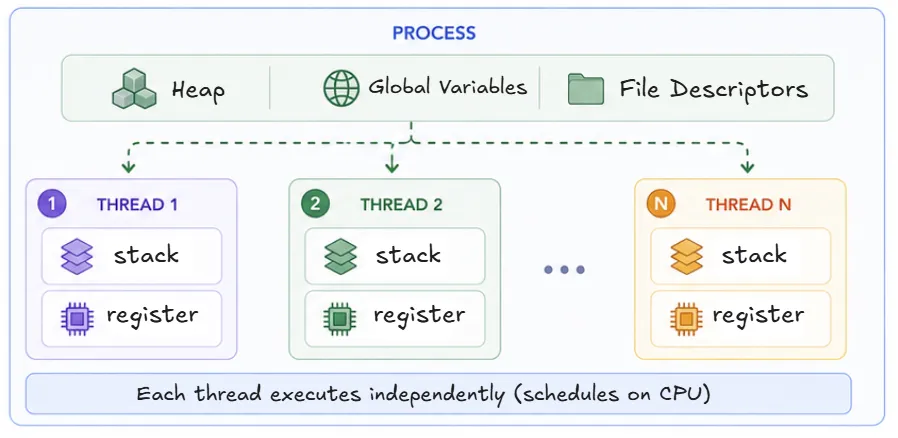
Threads are subtasks within a process that share resources but execute independently. Each thread:
- Has its own stack and registers.
- Shares the heap, global variables, and file descriptors with other threads in the same process.
- Enables faster execution compared to creating separate processes.
Example: Web Server Handling Requests
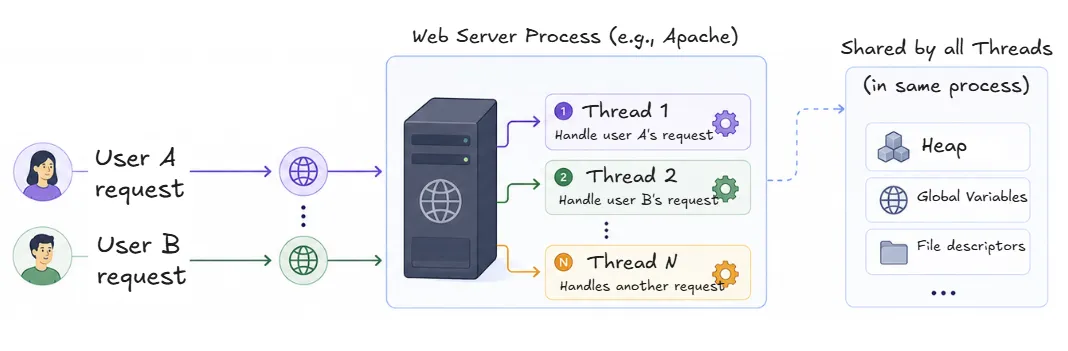
A web server like Apache creates multiple threads to serve incoming requests efficiently.
- Thread 1: Handles User A’s request.
- Thread 2: Handles User B’s request.
- Both share the same memory space but execute independently.
What is Fork()?
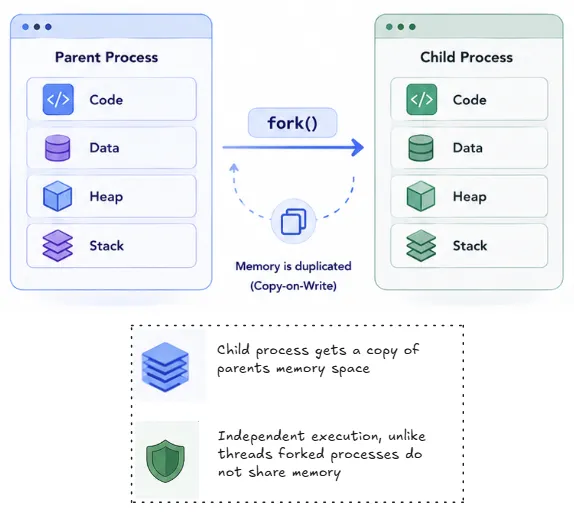
fork() is a system call that creates a new process by duplicating an existing one.
- The child process gets a copy of the parent’s memory space.
- Independent execution: Unlike threads, forked processes do not share memory.
Example: Running Multiple Instances
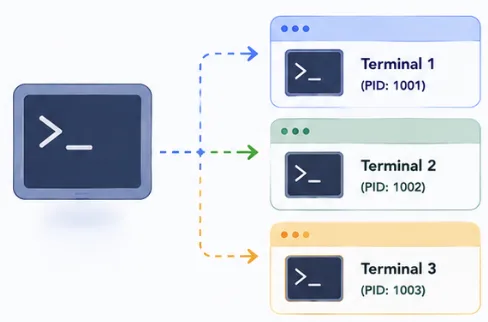
When you open multiple terminal windows, each runs as an independent process created using fork().
pid_t pid = fork();
if (pid == 0) {
    printf("Child Process\n");
} else {
    printf("Parent Process\n");
}
Threads vs. Fork
| Feature | Threads | Forked Processes |
|---|---|---|
| Memory Sharing | Yes | No |
| Speed | Faster | Slower (due to duplication) |
| Execution | Within the same process | Separate process |
| Used In | Multithreading apps (web servers, game engines) | Independent tasks (terminal sessions, process isolation) |
Conclusion
Threads improve performance by sharing memory, while fork() helps in process isolation. Choosing between them depends on application needs - whether you prioritize speed (threads) or separation (fork).