Greedy Algorithms
A greedy algorithm makes the best-looking choice at each step, hoping that these local choices lead to the best overall solution.
The key idea is simple:
Make the best choice you can right now, without worrying too much about future choices.
Greedy algorithms are often simple and efficient, but there is an important catch: A greedy choice does not always produce the optimal solution.
Let’s look at two examples.
Problem: Scheduling Classes
Suppose we have one classroom and several classes.
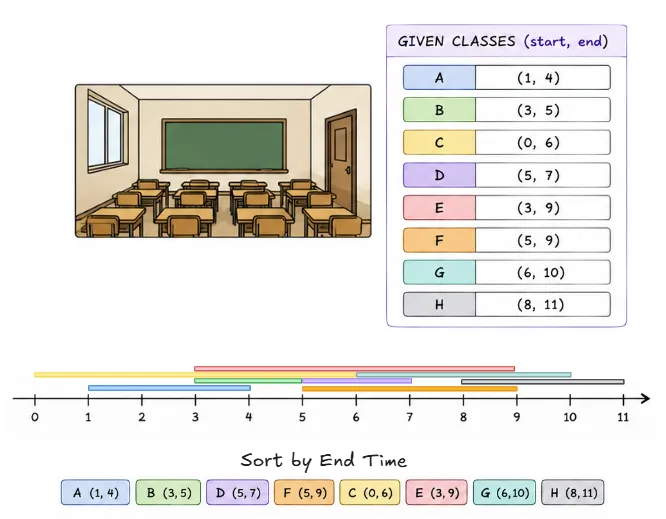
Each class has a start time and an end time, and we want to schedule as many classes as possible without overlapping them.
For example:
| Class | Start | End |
|---|---|---|
| A | 1 | 4 |
| B | 3 | 5 |
| C | 0 | 6 |
| D | 5 | 7 |
| E | 3 | 9 |
| F | 5 | 9 |
| G | 6 | 10 |
| H | 8 | 11 |
Which class should we choose first?
A good greedy choice is: Always choose the class that finishes earliest.
Why?
Because finishing early leaves as much room as possible for the remaining classes.
The algorithm becomes:
- Sort all classes by their end time.
- Select the class that finishes earliest.
- Select the next class whose start time is greater than or equal to the previous class’s end time.
- Repeat until no more classes can be selected.
For our example, the selection is:
A → D → H
So we can schedule 3 classes.
JavaScript Implementation
function scheduleClasses(classes) {
  // Sort by end time
  classes.sort((a, b) => a.end - b.end);

  const selected = [];
  let lastEndTime = -Infinity;

  for (const cls of classes) {
    if (cls.start >= lastEndTime) {
      selected.push(cls);
      lastEndTime = cls.end;
    }
  }

  return selected;
}

const classes = [
  { name: "A", start: 1, end: 4 },
  { name: "B", start: 3, end: 5 },
  { name: "C", start: 0, end: 6 },
  { name: "D", start: 5, end: 7 },
  { name: "E", start: 3, end: 9 },
  { name: "F", start: 5, end: 9 },
  { name: "G", start: 6, end: 10 },
  { name: "H", start: 8, end: 11 }
];

console.log(scheduleClasses(classes));
The important part is not the code itself, but the greedy choice: Choose the class that finishes earliest. For this problem, that choice is enough to produce an optimal solution.
Time Complexity
Sorting takes: O(n log n)
The single pass through the classes takes: O(n)
Therefore, the overall complexity is: O(n log n)
Problem: Knapsack Problem
Now let’s look at a problem where a greedy approach doesn’t always work.
Suppose you have a knapsack that can hold 35 kg. Your goal is to maximize the total value of the items you put into the bag.
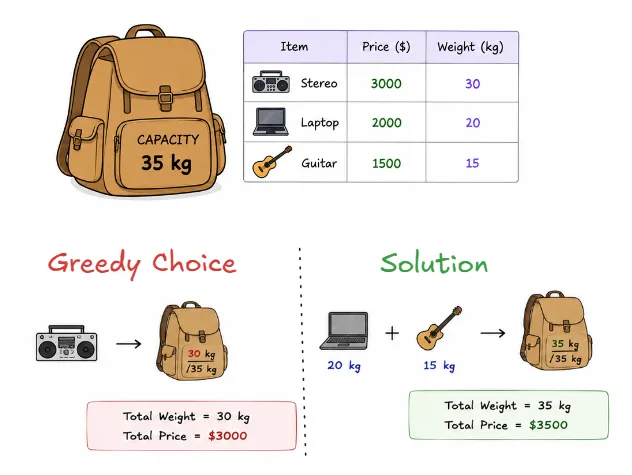
A shop has these items:
| Item | Price ($) | Weight (kg) |
|---|---|---|
| Stereo | 3000 | 30 |
| Laptop | 2000 | 20 |
| Guitar | 1500 | 15 |
Imagine we use the following greedy strategy: Pick the most valuable item first.
The Stereo is worth $3000, so we pick it. The bag now has only 5 kg of capacity left. Neither the Laptop nor the Guitar fits.
So the greedy solution gives us Value: $3000
Instead there did exist a better solution if we would have picked:
- Laptop → 20 kg → $2000
- Guitar → 15 kg → $1500 Making a total of 35 Kg and $3500