HashTables
What is a Hash Function?
A hash function takes an input of arbitrary size (such as a string or number) and converts it into a fixed-size integer called a hash code or hash value.
For example:
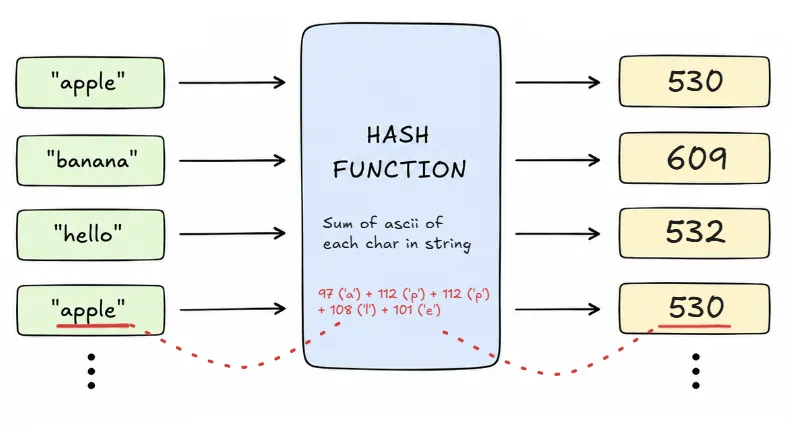
“apple” -> Hash Function -> 530
In this case apple is being passed through our simple hash function. This hash function takes each character’s ascii value and adds them. Simple enough.
A valid hash function must be deterministic: giving it the exact same input must always produce the exact same output.
What is a Hash Table ?
A hash table is a data structure that stores key-value pairs. It uses a hash function to convert a key into a hash value, which is then mapped to an index in an underlying array.
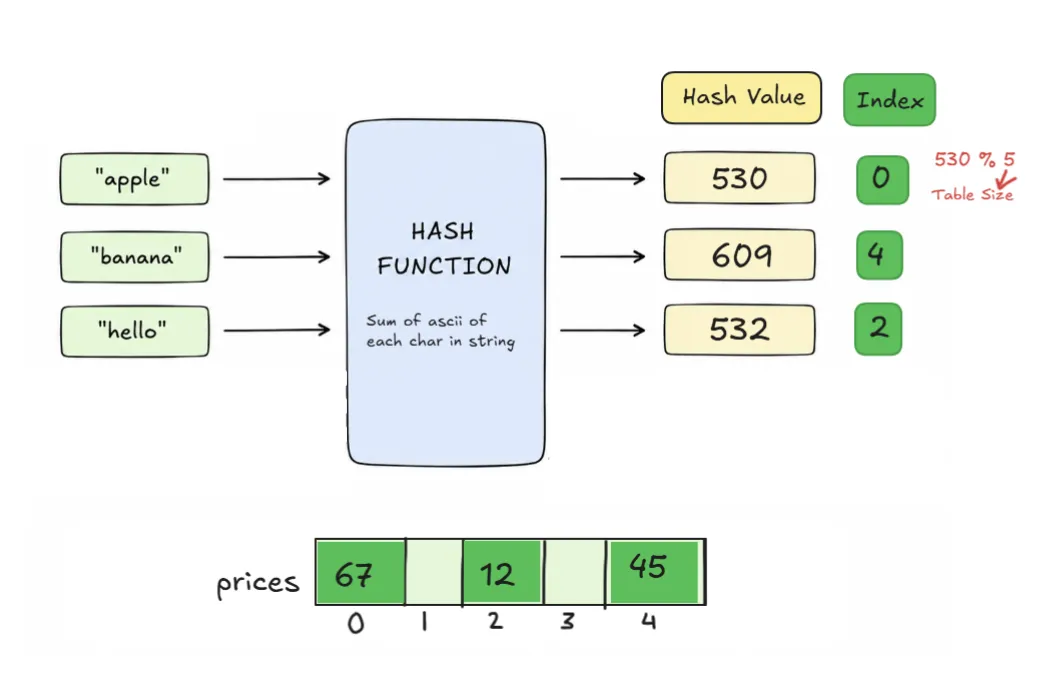
This allows us to find values quickly without searching through every element.
In JavaScript, Map provides a convenient key-value data structure:
const prices = new Map();

prices.set("apple", 67);
prices.set("banana", 45);
prices.set("hello", 12);

console.log(prices.get("apple")); // 67
Hash tables excel whenever you need rapid key-based access:
- DNS resolution: Mapping domain names to IP addresses (example.com -> 93.184.216.34)
- Caching: Storing expensive computation or database query results by request key
- Duplicate detection: Tracking whether a voter ID or username has already been processed
Handling Collisions
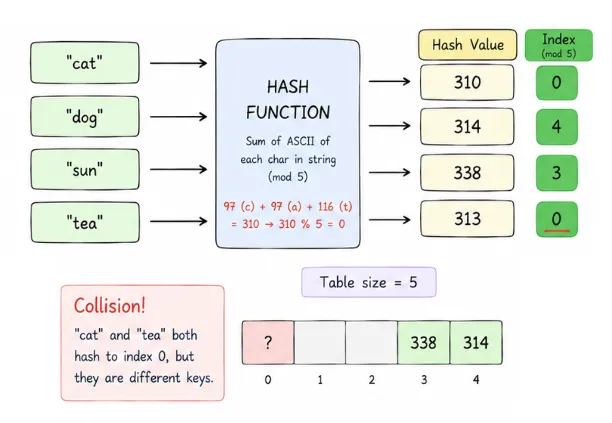
Because the universe of possible inputs is infinite while a hash table’s array size is finite, two completely different keys will eventually hash to the same slot. This event is called a collision.
A good hash function distributes keys evenly to minimize collisions, but every hash table must have a strategy to resolve them when they occur. The two most common methods are:
Chaining
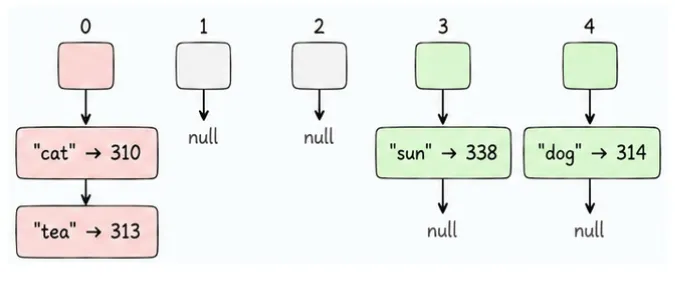
Each slot in the table points to a linked list (or dynamic array). When keys collide at index $i$, the new key-value pair is simply appended to the list at that slot.
Open Addressing (Linear/Quadratic Probing)
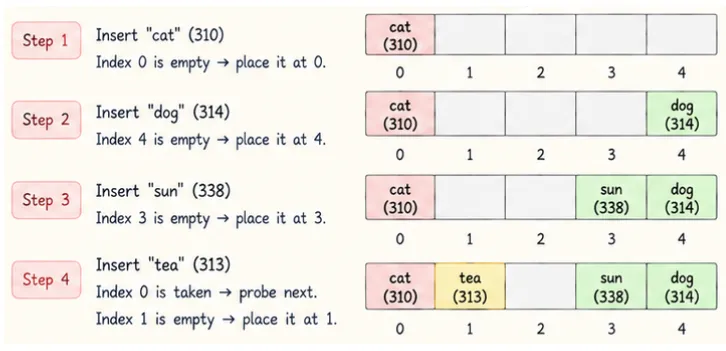
All elements live directly in the table. When a collision occurs, the table probes subsequent slots according to a fixed sequence until an empty slot is found.
Hash Table Performance
When the hash function distributes keys uniformly and the table retains enough empty space, basic operations are extremely fast:
- Lookup: O(1) average
- Insert: O(1) average
- Delete: O(1) average
In the worst-case scenario, such as when a poor hash function sends every single key to the exact same bucket performance degrades to O(n), reducing the structure to an ordinary linked list.
Load Factor and Resizing
To prevent degradation and keep operations running in O(1) time, hash tables monitor their load factor.
Load Factor = (Number of Items in Table) / (Total Number of Slots)
As the load factor climbs, empty slots become scarce and collision probability surges. Most implementations set a threshold commonly 0.70 to 0.75:
Once Load Factor exceeds the threshold,
- the table allocates a new underlying array (typically 2x the previous size).
- Because the array size has changed, old indices are no longer valid.
- Every existing entry is rehashed into its new location—a process known as rehashing.